Visiting Huaca Pucllana Archeological Site

Mummies Uncovered at Ancient Shrine in Lima, Peru

Visiting Huaca Pucllana Archeological Site
Ancient Shrine of Huaca Pucllana in Miraflores, Lima
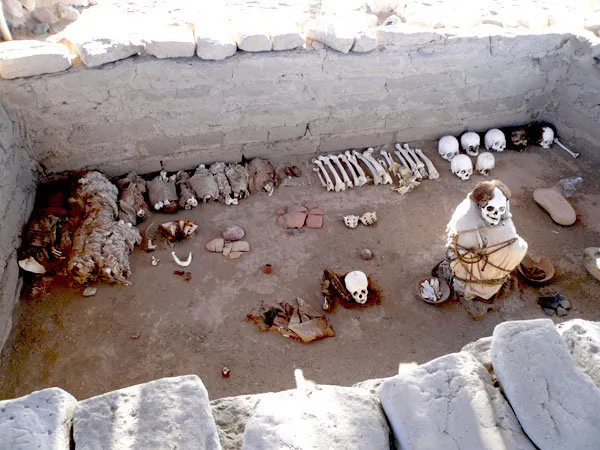
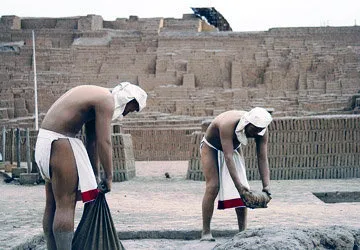
One of the exhibits showing the site's pre-Columbian life

Two thousand-year old mummies were uncovered this week at the ancient site of Huaca Pucllana in the coastal district of Miraflores in Lima, Peru. One of them is a baby believed to have been buried alive after the death of the adult, probably as an offering to the gods.

Two thousand-year old mummies were uncovered this week at the ancient site of Huaca Pucllana in Lima, Peru. One of them is a baby believed to have been buried alive after the death of the adult, probably as an offering to the gods. "This is one of the most important finds in more than three decades of excavation, because the mummies are intact," explained site researcher Gladys Paz. The mummies are squatting in a typical burial position for pre-Columbian cultures in the area, and are completely covered in rope. Other offerings accompanied the mummies, including guinea pig remains and jars with feline motifs.

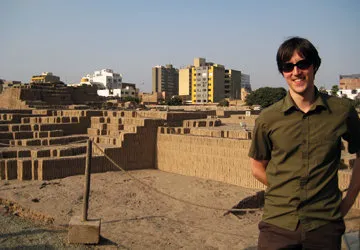
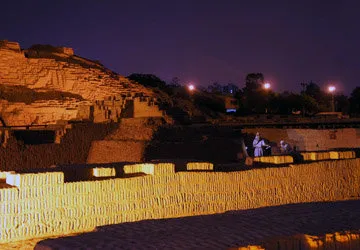
The religious complex is located amidst the modern urban buildings of Peru's coastal district of Miraflores, whose green cliffs overlook the Pacific Ocean. Almost entirely constructed of adobe bricks, Huaca Pucllana was built by the Lima culture (200-700DC) but also subsequently occupied by the Wari (800-900DC) and the Ychsma (1000-1532). In addition to the Great Pyramid, the complex includes a series of patios, plazas and enclosures. It has been under continual excavation since 1981, by a team lead by Dr. Isabel Flores Espinoza, although visitors are admitted despite the ongoing work. Frequent findings include ceramics with marine motifs such as sharks, waves, sea lions, squids.

The majority of human remains unearthed thus far have been human sacrifices, although evidence suggests that during the Wari occupation the highest parts of the Great Pyramid were destroyed and converted into an elite cemetery. The remains are mainly of young women, although males and children have also been found in much lower quantity. Recent discoveries include the remains of a woman with four children in 2010 and those of a teenage girl in 2008.

A touristic circuit allows for visitors to explore the site, with guides available at regular intervals throughout the day to lead tours in Spanish, English, Japanese, and French. Because more than half the site still hasn't been excavated, one must explore the site with its official guides. A visitor's center exhibits some of the primary findings of the archeological team, while a small park shows the plants cultivated and the animals raised during the time of the Lima.
Two thousand-year old mummies were uncovered this week at the ancient site of Huaca Pucllana in the coastal district of Miraflores in Lima, Peru. One of them is a baby believed to have been buried alive after the death of the adult, probably as an offering to the gods.

Two thousand-year old mummies were uncovered this week at the ancient site of Huaca Pucllana in Lima, Peru. One of them is a baby believed to have been buried alive after the death of the adult, probably as an offering to the gods. "This is one of the most important finds in more than three decades of excavation, because the mummies are intact," explained site researcher Gladys Paz. The mummies are squatting in a typical burial position for pre-Columbian cultures in the area, and are completely covered in rope. Other offerings accompanied the mummies, including guinea pig remains and jars with feline motifs.

The religious complex is located amidst the modern urban buildings of Peru's coastal district of Miraflores, whose green cliffs overlook the Pacific Ocean. Almost entirely constructed of adobe bricks, Huaca Pucllana was built by the Lima culture (200-700DC) but also subsequently occupied by the Wari (800-900DC) and the Ychsma (1000-1532). In addition to the Great Pyramid, the complex includes a series of patios, plazas and enclosures. It has been under continual excavation since 1981, by a team lead by Dr. Isabel Flores Espinoza, although visitors are admitted despite the ongoing work. Frequent findings include ceramics with marine motifs such as sharks, waves, sea lions, squids.

The majority of human remains unearthed thus far have been human sacrifices, although evidence suggests that during the Wari occupation the highest parts of the Great Pyramid were destroyed and converted into an elite cemetery. The remains are mainly of young women, although males and children have also been found in much lower quantity. Recent discoveries include the remains of a woman with four children in 2010 and those of a teenage girl in 2008.

A touristic circuit allows for visitors to explore the site, with guides available at regular intervals throughout the day to lead tours in Spanish, English, Japanese, and French. Because more than half the site still hasn't been excavated, one must explore the site with its official guides. A visitor's center exhibits some of the primary findings of the archeological team, while a small park shows the plants cultivated and the animals raised during the time of the Lima.
News, routes, and expert tips

Explore the latest from our Cusco travel blog. Get practical guides, Machu Picchu updates, and fresh trekking and culture recommendations. Everything you need to travel Cusco safely and stylishly in 2026. Your next Andean story starts here!

Inca World Traveñ 48 km on foot: How to reach the Señor de Huanca in Cusco

Every September 14, thousands of people walk 48 kilometers from the city of Cusco to the sanctuary of the Señor de Huanca, in the district of San Salvador, province of Calca, at 3,100 m.a.s.l. It is neither a tourist trekking trip nor an organized tour: it is a genuine pilgrimage that sets off at night from San Jerónimo and arrives at dawn on the main day. Here we explain the route, what it physical demands, and why this tradition continues to draw devotees from all over Peru and neighboring countries.

Carla Colon How to Get to Machu Picchu: Complete Guide by Train, Bus, or Hiking

Planning your trip to Peru? Discover the best ways to reach Machu Picchu from Cusco. Compare options by train, bus, budget routes, and legendary trekking trails like the Inca Trail and Salkantay.

Inca World Travel Your ticket to Machu Picchu cannot be lent: What you need to know before the holiday

With the national holiday on August 6 (Battle of Junín) right around the corner, many travelers are organizing last-minute visits to Machu Picchu. Before buying, there is a rule that causes more trouble than it seems: the ticket is personal, unique, and non-transferable. Learn how this rule works at the checkpoint, why you cannot give your ticket away, and how to avoid inconveniences to enjoy your trip to the sanctuary with complete peace of mind.

Are you planning to visit
Machu Picchu in 2026?

We would like to inform our travelers that availability for Circuit 1 and 2 for the months of September, October and November is at 85% of capacity. We recommend booking at least 3 months in advance.

New Circuits and Routes

The Ministry of Culture has consolidated the three main tours. As of 2026, Tour 2 (The Royal Route) remains the only one that allows visitors to take the classic photo from the Guardian’s House. We have adapted all our packages to ensure this access.

Digital Check-In and Biometric Verification

Say goodbye to long check-in lines! Starting this season, entry is faster thanks to the new digital check-in system. Our packages include full management of your personalized tickets to prevent errors on the state platform.

Circuit Ideal for... Clasic photo Difficulty
Circuit 1 (Panoramic) High views and photo posts Yes Low
Circuit 2 (Andean) Complete circuit through the ruins Yes Medium
Circuit 3 (Reality) Persons or reduced movement No Very low

Ask about our Machu Picchu packages

Explore the best of our land

Explore the breathtaking diversity of the Central Andes. From ancient archaeological wonders and surreal high-altitude landscapes to world-class gastronomy and Amazonian adventures, our updated 2026 guides showcase the very best of this premier global destination.