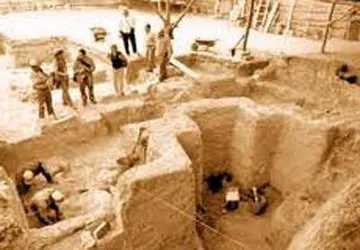
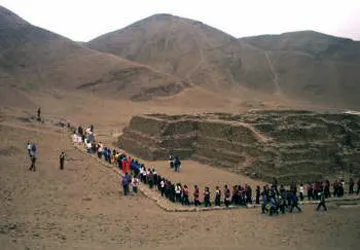
Cover Photo. Archeological Team working near Lima, Peru

Older Than Stonehenge: Peruvian Archeologists Discover Ancient Temple in Lima

Cover Photo. Archeological Team working near Lima, Peru
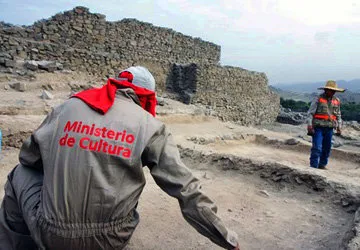
Ministry of Culture archeologists working at El Paraiso.
Crowd around the newly unearthed temple at El Paraiso.

Archeologists in Peru announced the discovery of an ancient temple at El Paraiso Archeological Complex in the Chillon valley just northeast of Lima. Dating back 5,000 years, the newly discovered temple (dubbed the Temple of Fire) will provide invaluable insight into one of the Americas' oldest populated sites.

Last week archeologists in Peru announced the discovery of a temple just northeast of Lima, at El Paraiso Archeological Complex in the Chillon valley. The complex is said to house ten architectural units, including temples, plazas, and residences, which once housed an estimated 3,000 people, but up to now only the central pyramid has been uncovered.

Dating back 5,000 years, the newly discovered temple will provide invaluable insight into one of the Americas' oldest populated sites. Researchers from the Peruvian Ministry of Culture have suggested that it could be a temple, and have shared that it contains signs suggesting the use of ritual fire. Its narrow entrance, measuring only 19inches, was discovered by the archeological team under Marco Guillen while they were removing sand and stones from El Paraíso's central pyramid. It led the archeologists into a 26 by 20 foot chamber where it appears that flowers, fruit, shellfish, and grains were burnt as offerings. The walls were finely coated in yellow soil and still bear traces of red paint. Guillen explained that "the smoke allowed the priests to connect with the gods," and indicated that upon passing the chamber, the temple has four levels, each successively older than the last. The entrance's small size meant that only one person could enter the central room at the time. "There is a lot to discover in order to untangle the mysteries held at El Pariso," Guillen added, "we need to know if below these structures there are even older ones. We just began and already found the Temple of Fire," he said.

The rectangular building is built of stone but research indicates that it was once plastered with mud and decorated with red paint. While it is said to be comparable in age to the nearby Sacred City of Caral, it displays characteristics which make it, in the words of the Ministry of Culture's Deputy Minister Rafael Male Gabai, "the first of this type of structure that is located in the central coast, which confirms that the current Lima region was one of the centers of civilization in the Andean region, demonstrating its religious, economic and political (value) since time immemorial." One thing is clear- the site showcases a ‘construction blueprint' with echoes throughout the Andean peaks and the following centuries, proving that the Andean world was more closely connected than previously thought.

Gabai hopes that the findings inspire greater preservation (as the site has problems with squatters) and further research. His wish may be granted, as the Humala administration has allocated US$1.8 million for research at the site to be conducted over the next five years.
Archeologists in Peru announced the discovery of an ancient temple at El Paraiso Archeological Complex in the Chillon valley just northeast of Lima. Dating back 5,000 years, the newly discovered temple (dubbed the Temple of Fire) will provide invaluable insight into one of the Americas' oldest populated sites.

Last week archeologists in Peru announced the discovery of a temple just northeast of Lima, at El Paraiso Archeological Complex in the Chillon valley. The complex is said to house ten architectural units, including temples, plazas, and residences, which once housed an estimated 3,000 people, but up to now only the central pyramid has been uncovered.

Dating back 5,000 years, the newly discovered temple will provide invaluable insight into one of the Americas' oldest populated sites. Researchers from the Peruvian Ministry of Culture have suggested that it could be a temple, and have shared that it contains signs suggesting the use of ritual fire. Its narrow entrance, measuring only 19inches, was discovered by the archeological team under Marco Guillen while they were removing sand and stones from El Paraíso's central pyramid. It led the archeologists into a 26 by 20 foot chamber where it appears that flowers, fruit, shellfish, and grains were burnt as offerings. The walls were finely coated in yellow soil and still bear traces of red paint. Guillen explained that "the smoke allowed the priests to connect with the gods," and indicated that upon passing the chamber, the temple has four levels, each successively older than the last. The entrance's small size meant that only one person could enter the central room at the time. "There is a lot to discover in order to untangle the mysteries held at El Pariso," Guillen added, "we need to know if below these structures there are even older ones. We just began and already found the Temple of Fire," he said.

The rectangular building is built of stone but research indicates that it was once plastered with mud and decorated with red paint. While it is said to be comparable in age to the nearby Sacred City of Caral, it displays characteristics which make it, in the words of the Ministry of Culture's Deputy Minister Rafael Male Gabai, "the first of this type of structure that is located in the central coast, which confirms that the current Lima region was one of the centers of civilization in the Andean region, demonstrating its religious, economic and political (value) since time immemorial." One thing is clear- the site showcases a ‘construction blueprint' with echoes throughout the Andean peaks and the following centuries, proving that the Andean world was more closely connected than previously thought.

Gabai hopes that the findings inspire greater preservation (as the site has problems with squatters) and further research. His wish may be granted, as the Humala administration has allocated US$1.8 million for research at the site to be conducted over the next five years.
News, routes, and expert tips

Explore the latest from our Cusco travel blog. Get practical guides, Machu Picchu updates, and fresh trekking and culture recommendations. Everything you need to travel Cusco safely and stylishly in 2026. Your next Andean story starts here!

Inca World Travel Seven Natural Wonders Hidden By Peru Discover Now

Ready to explore beyond Machu Picchu? Discover the 7 natural wonders of Peru, a country brimming with hidden ecological treasures. From deep turquoise lagoons and the famous rainbow mountain of colors to surreal stone forests and vast rivers, these stunning destinations are waiting for you. Get ready to dive into the raw, untouched beauty of South America!

Inca World Historic Center of Cusco Tours: The Ideal Cultural Walking Itinerary

Cusco is a city meant to be explored on foot. Every street holds a story, and as you walk, you feel as though you aren't just "visiting" a city, but rather walking through layers of a living past: the Inca world and the Spanish Baroque, seamlessly blended in stone.That is why, if it is your first time in Cusco, the historic center is one of the best ways to kick off your trip. Additionally, sitting at around 3,400 meters 11,150 feet above sea level, a relaxed stroll helps you acclimate to the altitude, making you feel much better before taking on longer or more demanding excursions.

Inca World Travel How to Travel from Pisco to Cusco: Flights, Routes, and Travel Tips

Are you planning your trip to Peru and want to combine the magic of the Ica Desert with the majesty of the Andes? Connecting the southern coast with the heart of the world is one of the best decisions you can make.

Here, we’ll tell you everything you need to know about the route from Pisco to Cusco, flight options, and how to plan your itinerary so you don’t miss a thing.

Are you planning to visit
Machu Picchu in 2026?

We would like to inform our travelers that availability for Circuit 1 and 2 for the months of September, October and November is at 85% of capacity. We recommend booking at least 3 months in advance.

New Circuits and Routes

The Ministry of Culture has consolidated the three main tours. As of 2026, Tour 2 (The Royal Route) remains the only one that allows visitors to take the classic photo from the Guardian’s House. We have adapted all our packages to ensure this access.

Digital Check-In and Biometric Verification

Say goodbye to long check-in lines! Starting this season, entry is faster thanks to the new digital check-in system. Our packages include full management of your personalized tickets to prevent errors on the state platform.

Circuit Ideal for... Clasic photo Difficulty
Circuit 1 (Panoramic) High views and photo posts Yes Low
Circuit 2 (Andean) Complete circuit through the ruins Yes Medium
Circuit 3 (Reality) Persons or reduced movement No Very low

Ask about our Machu Picchu packages

Explore the best of our land

Explore the breathtaking diversity of the Central Andes. From ancient archaeological wonders and surreal high-altitude landscapes to world-class gastronomy and Amazonian adventures, our updated 2026 guides showcase the very best of this premier global destination.