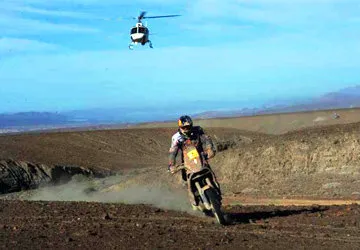
Dakar Rally motorcyclist races through the Peruvian desert.

The Route is Set: This January Dakar 2013 will begin in Lima

Dakar Rally motorcyclist races through the Peruvian desert.
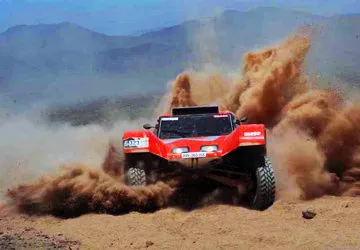
Trailing dust clouds towards the Dakar Rally finish in Lima,
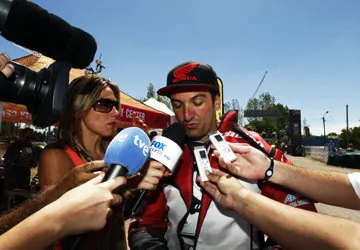
Veteran race JP Fontenay is interviews in between stages.

A demanding and exciting route's been announced for this January's Dakar 2013, which is expected to bring more than a million spectators to its starting point in Lima and 10,000 to Arequipa. Challenges will include the largest chain of dunes the off-road racers have ever had to face, and the south to north route is expected to cause some big gaps and high drama early on.

The organizing team for Dakar 2013, the world's most demanding rally, has set the route for the coming race. Over the last thirty-five years, the race has gained an ever-increasing roster of die-hard fans. Although it originally set off from Paris and traversed the Sahara desert en route to Dakar in Senegal, safety concerns caused the switch from Africa to South America five years ago. The challenging South American terrain has allowed the race, which has claimed a number of lives during its history, to continue with no loss of drama.

Residents of Peru's capital, affectionately known as the City of Kings, came out in force early this year at the end of Dakar 2012- more than a million spectators gathered to welcome the drivers as they rode into Lima, Peru for the win. In contrast, Dakar 2013 is turning the race on its head: this January 5th, the racers will speed out of Lima as the race's starting point and finish in Santiago fifteen days later. As Dakar director Etienne Lavigne explained, "Peru, Argentina and Chile, explored on a north to south journey, will offer the Dakar a different angle of attack on the Pacific Coast, the Atacama's dunes and the Andes Mountains".

Declarations on the rally's official website exhibit its customary boldness: "Dakar 2013: Exceptional is the Watchword." The new route means that racers will have to tackle the sandy and rocky dunes along Peru's desert coast in the very beginning of the race. Dakar's Sporting Director David Castera predicted that this will lead to more drama and some big gaps early on.

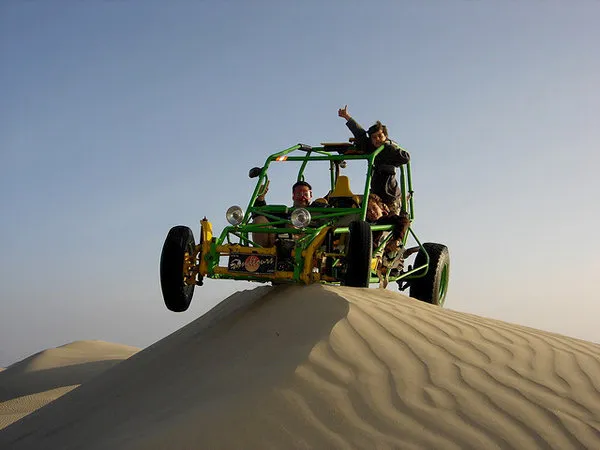
This is the first time in Dakar history that the race will begin in the middle of the desert, and things won't get any easier once the drivers reach the Andes Mountains. After 5 stages in Peru, there will be 5 more in Argentina, some of which will be exceptionally long in a test of endurance. Finally, drivers will enjoy a rest day in Argentina's San Miguel de Tucuman.  As drivers leave Gaucho country, they'll have to contend with the unwelcoming Atacama desert in Chile in the largest chain of dunes that racers have ever had to face. All in all, they will face 4,970 miles of varied and challenging terrain before the race's end in Santiago. As veteran racer and 1998 Dakar winner Jean-Pierre Fontenay warned, "It will be tough out there" He later added, "They'll be very pleased even to reach the rest day."

Lima isn't the only city that will be feeling the love this year- Arequipa in southern Peru expects a huge tourism boost much like last year, with 10,000 tourists expected to visit the White City on January 8th.
A demanding and exciting route's been announced for this January's Dakar 2013, which is expected to bring more than a million spectators to its starting point in Lima and 10,000 to Arequipa. Challenges will include the largest chain of dunes the off-road racers have ever had to face, and the south to north route is expected to cause some big gaps and high drama early on.

The organizing team for Dakar 2013, the world's most demanding rally, has set the route for the coming race. Over the last thirty-five years, the race has gained an ever-increasing roster of die-hard fans. Although it originally set off from Paris and traversed the Sahara desert en route to Dakar in Senegal, safety concerns caused the switch from Africa to South America five years ago. The challenging South American terrain has allowed the race, which has claimed a number of lives during its history, to continue with no loss of drama.

Residents of Peru's capital, affectionately known as the City of Kings, came out in force early this year at the end of Dakar 2012- more than a million spectators gathered to welcome the drivers as they rode into Lima, Peru for the win. In contrast, Dakar 2013 is turning the race on its head: this January 5th, the racers will speed out of Lima as the race's starting point and finish in Santiago fifteen days later. As Dakar director Etienne Lavigne explained, "Peru, Argentina and Chile, explored on a north to south journey, will offer the Dakar a different angle of attack on the Pacific Coast, the Atacama's dunes and the Andes Mountains".

Declarations on the rally's official website exhibit its customary boldness: "Dakar 2013: Exceptional is the Watchword." The new route means that racers will have to tackle the sandy and rocky dunes along Peru's desert coast in the very beginning of the race. Dakar's Sporting Director David Castera predicted that this will lead to more drama and some big gaps early on.

This is the first time in Dakar history that the race will begin in the middle of the desert, and things won't get any easier once the drivers reach the Andes Mountains. After 5 stages in Peru, there will be 5 more in Argentina, some of which will be exceptionally long in a test of endurance. Finally, drivers will enjoy a rest day in Argentina's San Miguel de Tucuman.  As drivers leave Gaucho country, they'll have to contend with the unwelcoming Atacama desert in Chile in the largest chain of dunes that racers have ever had to face. All in all, they will face 4,970 miles of varied and challenging terrain before the race's end in Santiago. As veteran racer and 1998 Dakar winner Jean-Pierre Fontenay warned, "It will be tough out there" He later added, "They'll be very pleased even to reach the rest day."

Lima isn't the only city that will be feeling the love this year- Arequipa in southern Peru expects a huge tourism boost much like last year, with 10,000 tourists expected to visit the White City on January 8th.
News, routes, and expert tips

Explore the latest from our Cusco travel blog. Get practical guides, Machu Picchu updates, and fresh trekking and culture recommendations. Everything you need to travel Cusco safely and stylishly in 2026. Your next Andean story starts here!

Inca World Traveñ 48 km on foot: How to reach the Señor de Huanca in Cusco

Every September 14, thousands of people walk 48 kilometers from the city of Cusco to the sanctuary of the Señor de Huanca, in the district of San Salvador, province of Calca, at 3,100 m.a.s.l. It is neither a tourist trekking trip nor an organized tour: it is a genuine pilgrimage that sets off at night from San Jerónimo and arrives at dawn on the main day. Here we explain the route, what it physical demands, and why this tradition continues to draw devotees from all over Peru and neighboring countries.

Carla Colon How to Get to Machu Picchu: Complete Guide by Train, Bus, or Hiking

Planning your trip to Peru? Discover the best ways to reach Machu Picchu from Cusco. Compare options by train, bus, budget routes, and legendary trekking trails like the Inca Trail and Salkantay.

Inca World Travel Your ticket to Machu Picchu cannot be lent: What you need to know before the holiday

With the national holiday on August 6 (Battle of Junín) right around the corner, many travelers are organizing last-minute visits to Machu Picchu. Before buying, there is a rule that causes more trouble than it seems: the ticket is personal, unique, and non-transferable. Learn how this rule works at the checkpoint, why you cannot give your ticket away, and how to avoid inconveniences to enjoy your trip to the sanctuary with complete peace of mind.

Are you planning to visit
Machu Picchu in 2026?

We would like to inform our travelers that availability for Circuit 1 and 2 for the months of September, October and November is at 85% of capacity. We recommend booking at least 3 months in advance.

New Circuits and Routes

The Ministry of Culture has consolidated the three main tours. As of 2026, Tour 2 (The Royal Route) remains the only one that allows visitors to take the classic photo from the Guardian’s House. We have adapted all our packages to ensure this access.

Digital Check-In and Biometric Verification

Say goodbye to long check-in lines! Starting this season, entry is faster thanks to the new digital check-in system. Our packages include full management of your personalized tickets to prevent errors on the state platform.

Circuit Ideal for... Clasic photo Difficulty
Circuit 1 (Panoramic) High views and photo posts Yes Low
Circuit 2 (Andean) Complete circuit through the ruins Yes Medium
Circuit 3 (Reality) Persons or reduced movement No Very low

Ask about our Machu Picchu packages

Explore the best of our land

Explore the breathtaking diversity of the Central Andes. From ancient archaeological wonders and surreal high-altitude landscapes to world-class gastronomy and Amazonian adventures, our updated 2026 guides showcase the very best of this premier global destination.