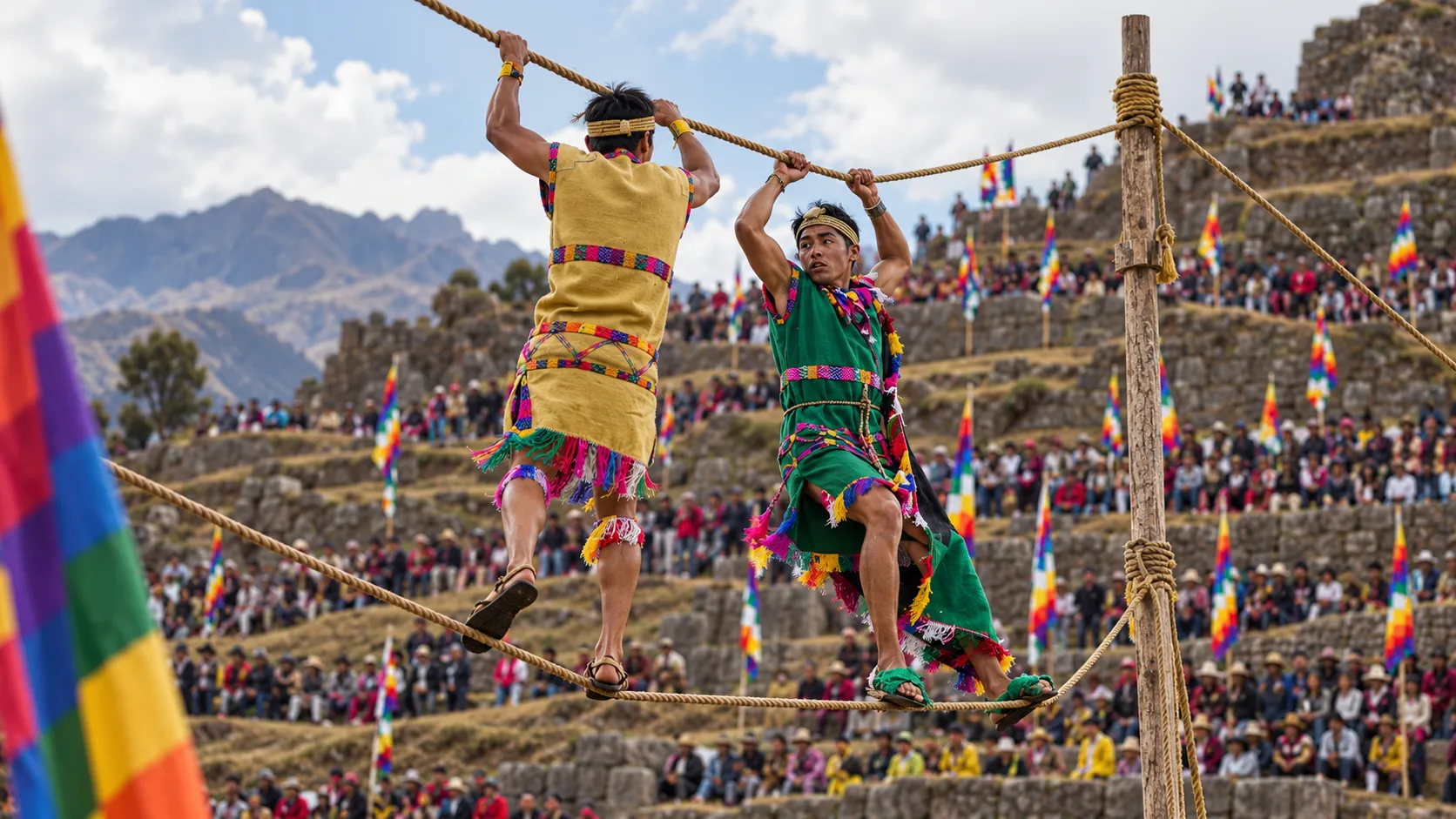
Every third Sunday of September, the ancient capital of Tahuantinsuyo revives one of its most demanding and solemn traditions. Far from being a simple choreography or stage performance, Warachicuy gathers over a thousand students who test their courage, physical endurance, and collective spirit on the very same sacred stones where their ancestors forged the empire.
What you see when you reach the esplanade
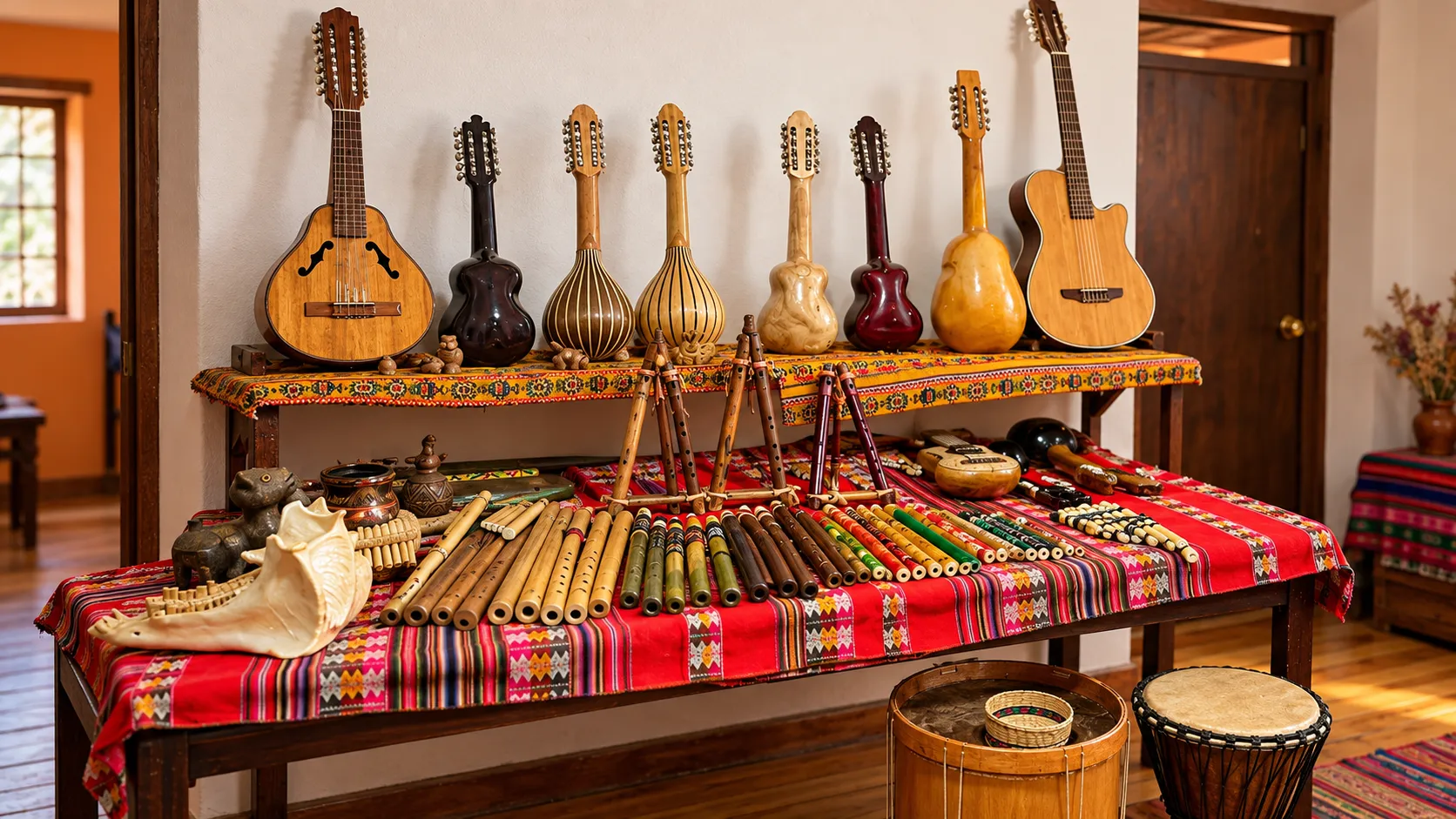
Before any event begins, what hits you first is the sound. Nearly 60 musicians play quenas, quenachos, phuñas, wankaras, zampoñas, and sikus directly into the Sacsayhuamán wind, at more than 3,400 meters above sea level. The sound echoes off the megalithic stones and arrives even before any image does.
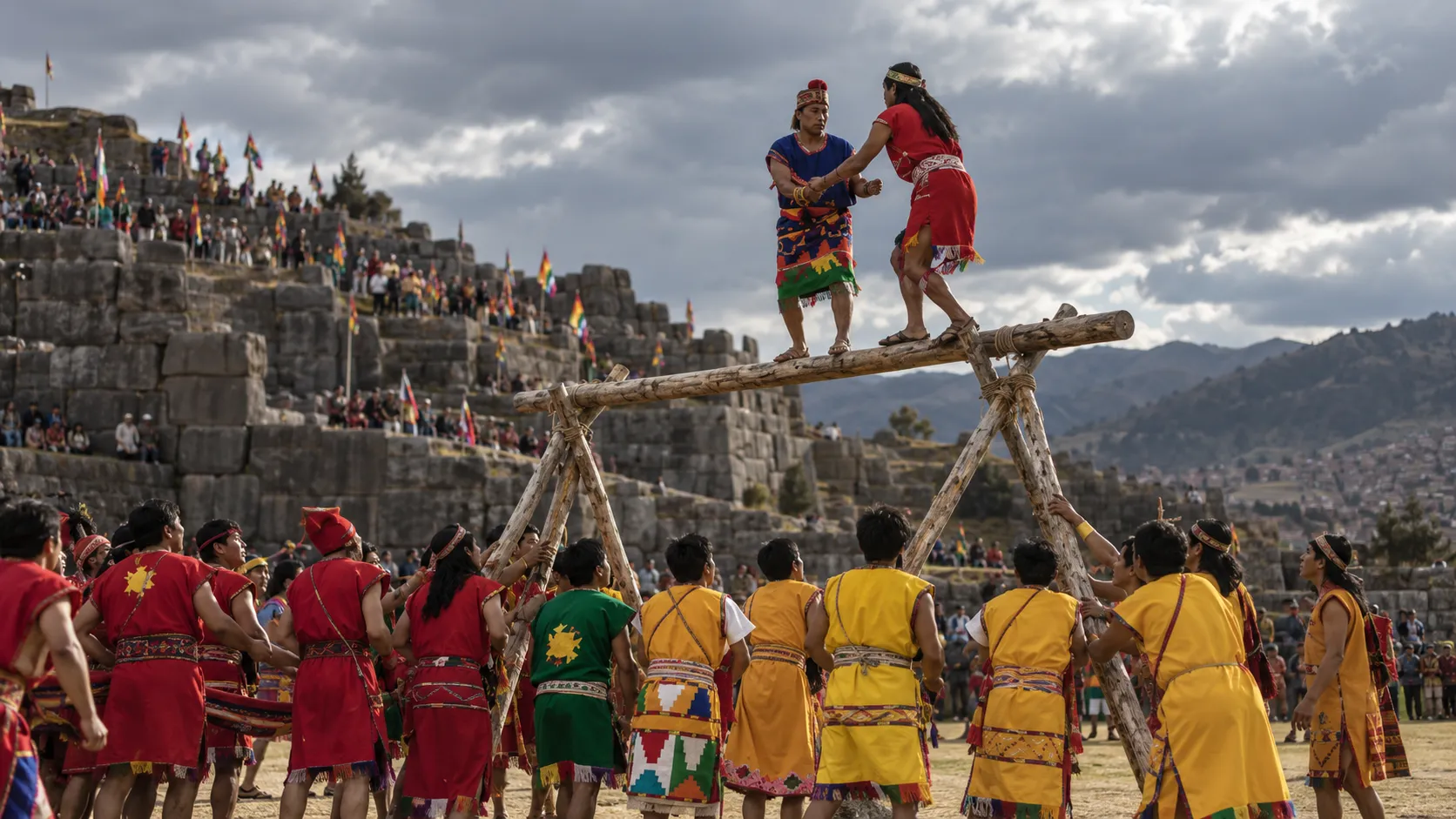
More than 10,000 people gather on the Chukipampa esplanade, the exact space where, according to historical reenactment, the young people of the empire demonstrated their abilities before taking on new responsibilities within Inca society.
The esplanade where this takes place is not a stage built for the occasion: it is Sacsayhuamán, the megalithic complex that chroniclers mistook for a fortress.
Official access information is available on the COSITUC website, while the official MINCETUR datasheet compiles information on its Quechua toponymy, archaeological description, and festivities associated with the site.
The procession: from the school to the esplanade
The procession does not start at Sacsayhuamán. It begins at the Colegio Nacional de Ciencias del Cusco, one of the oldest and most iconic educational institutions in the city, where participants prepare for months.
From there, they process through the Aucaypata—the modern Plaza de Armas of Cusco—and ascend to the Chukipampa esplanade in Sacsayhuamán, following a route that connects the historical center with one of the ancient Inca capital's most important ceremonial spaces.
If this procession through the historical center sparks your curiosity about the Imperial City, you can explore Inca and colonial Cusco in a single day, visiting Qoricancha, the Cathedral, Sacsayhuamán, and the archaeological complexes surrounding the city.
The trials: this is not an act
These young men are running for real. At over 3,400 meters above sea level, across uneven terrain with real obstacles, they take part in speed, endurance, strength, and coordination trials designed to capture the rigor of the ancient rite of passage.
- Speed and endurance: cross-country races over steep slopes and rough terrain.
- Team strength: rope climbs and exercises requiring collective coordination.
- Skill and marksmanship: challenges demanding precision, agility, and physical control.
- Balance and coordination: tests inspired by the skills expected of the young aspirants of Tahuantinsuyo.
In Tahuantinsuyo, aspirants were trained to face physical, social, and ritual trials marking their transition into adulthood. Demonstrating strength was not enough: discipline, leadership capacity, and commitment to the community were also expected.
Those who passed the trials received the wara, a ceremonial garment signifying entry into a new stage of life.
The reenactment concludes when the “Inca” proclaims in Quechua: “Haylliy wayna inkakuna!”, an expression symbolizing the victory of the young participants.
Not just a performance: recognized heritage
In July 2025, the Ministry of Culture declared the reenactment and staging of Warachicuy to be of Cultural Interest.
This recognition reinforces the cultural and educational value of a tradition that Colegio Nacional de Ciencias has sustained for decades, bringing together students, teachers, and much of the Cusco community.
The sky that organized the Andean world
Warachicuy was closely tied to the ceremonial calendar of the Inca world and to Cápac Raymi, one of the most vital celebrations in the Andean cycle. Observing the Sun, stars, and agricultural cycles was essential to organizing life in Tahuantinsuyo.
If you want to understand how the Incas interpreted the cosmos, the Astronomy Tour at Planetarium Cusco offers an immersive look at Andean astronomy and how the sky influenced agricultural and ceremonial calendars.
Garments that told your story
In the Andean world, textiles communicated identity, origin, societal function, and status. Colors, patterns, and weaving techniques formed a visual language that went far beyond decoration.
This connection between textile and identity remains alive in communities like Willoq. If this aspect of the ceremony sparks your interest, the ancient textiles of Willoq in the Sacred Valley tour offers a firsthand look at one of the most representative textile art forms in the Andes.
Ceremonial foods and flavors
Food played a central role in Andean celebrations. Corn, chicha de jora, and native Andean produce were essential elements of both daily life and ceremonial events.
If you would like to explore the flavors that endure in Cusqueña gastronomy, discover the Inca cuisine still prepared in Cusco today.
You can also learn more about one of the animals most deeply linked to Andean culinary and ritual traditions in the Andean guinea pig: a four-legged cultural feast.
Same esplanade, another grand ceremony
Sacsayhuamán is also one of the main settings for Inti Raymi. While the two celebrations carry distinct meanings, they share the same monumental landscape and form a vital part of Cusco's contemporary cultural calendar.
You can learn more about the Festival of Inti Raymi and its significance in Cusco's heritage.
And if you want to experience this celebration in June, the Full Day Inti Raymi Tour covers the ceremony's primary settings, from Qoricancha to Sacsayhuamán.
If the ceremony connected you to the Andean spirit
Warachicuy conveys a concept deeply rooted in the Andean worldview: learning by doing and stepping up to responsibilities within the community.
If this celebration has inspired you to experience living traditions, stay with local families, and connect directly with Andean culture, your journey can continue beyond Sacsayhuamán.
Experience Andean traditions live: book the Ccorcor experiential tourism and Huchuy Qosqo trekking tour with Inca World.